

WPC DOOR FRAME PRICE IN INDIA 2026 SIZE-WISE COST GUIDE
October 14, 2026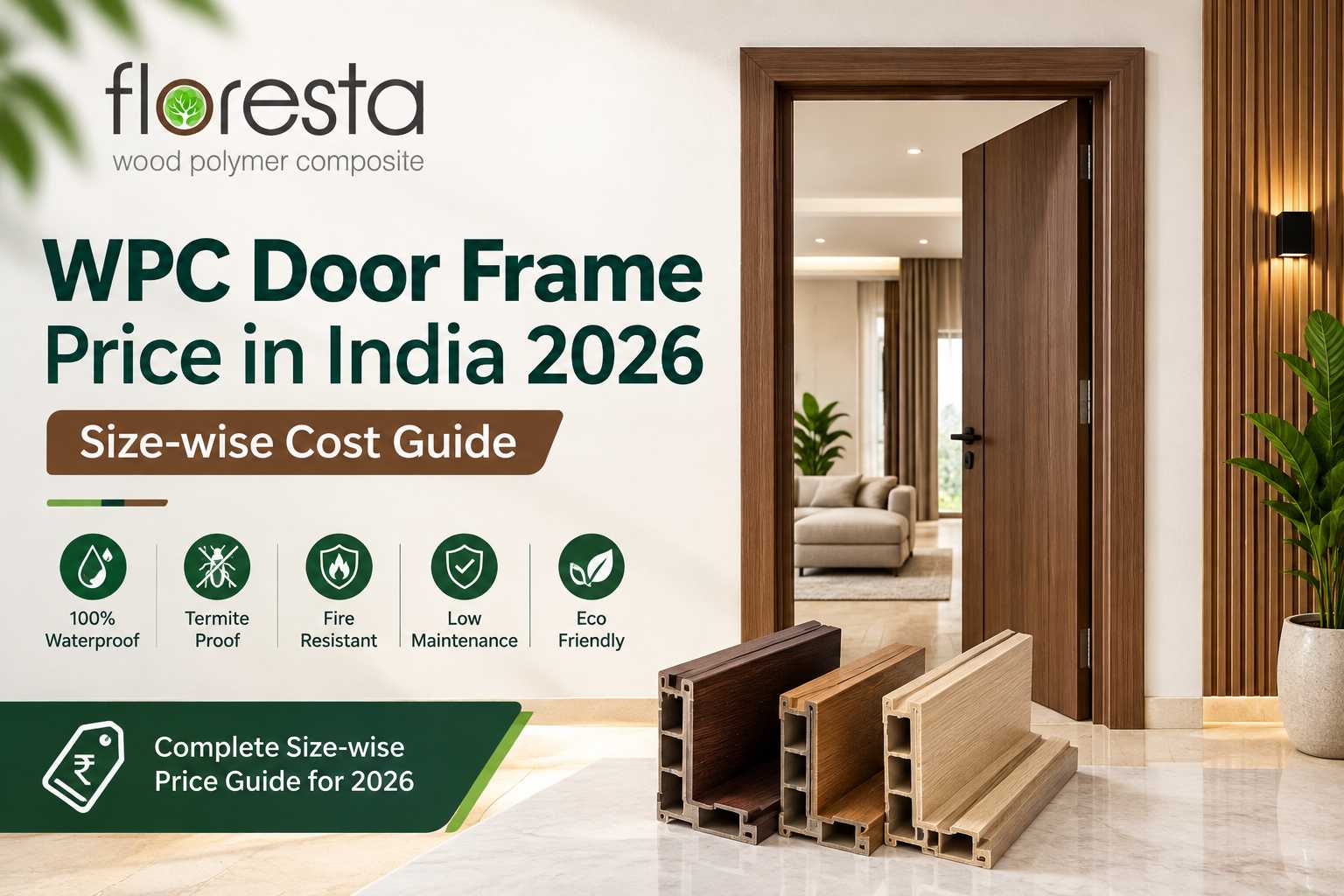
WPC DOOR FRAME PRICE IN INDIA 2026 SIZE-WISE COST GUIDE
When people start budgeting for doors, the shutter gets all the attention. Designs, laminates, handles. The frame is treated as an afterthought until the quotation arrives and one line item looks far higher or lower than expected. Then the questions begin. Why is one supplier charging per piece and another per foot? What does thickness have to do with price? Is a cheaper frame a bargain or a warning sign?
This guide answers those questions. We will look at the WPC door frame price in India, how size and thickness change the cost, how WPC compares with wood and steel, and what to check before you buy.
What Is a WPC Door Frame?
WPC stands for Wood Polymer Composite. Wood fibre is blended with polymer resins and additives, then shaped under heat and pressure into solid profiles. The result is a frame that does not swell with moisture, is not a food source for termites and does not rust.
Because it is factory made, every piece is uniform. There are no knots, hidden cracks or batch-to-batch surprises like those that come with cut timber. That consistency is a big part of why builders and homeowners have been shifting towards it.
WPC Door Frame Price in India: The Basics
Pricing in this category is usually quoted in one of two ways:
Per piece or per set, meaning a complete frame cut to a stated size
Per running foot, where the cost is calculated on the total length of frame used
The WPC door frame per feet price commonly falls in an indicative range of ₹130 to ₹250 per running foot, depending on thickness, density and brand. A complete frame for a standard door generally lands between ₹2,500 and ₹6,500 per piece.
Please treat these as market guidelines, not fixed rates. Prices change with raw material costs, city, transport and order volume. Always ask for a written quote.
Size-wise Cost Guide
Here is an approximate planning table for common openings. It assumes a standard 4 x 2.5 inch profile and plain finish.
These are indicative figures. The final price depends on exact dimensions, thickness and finish.
Understanding WPC Door Frame Size
The WPC door frame size you need depends on the room and the wall. Common standards in Indian homes include:
Height: 6.5 to 7 feet, with 7 feet being the most common for bedrooms and main doors
Width: 2 to 2.5 feet for bathrooms, 2.5 to 3 feet for internal rooms, and 3 to 3.5 feet for main entrances
Profile (section) size: commonly 4 x 2 inches, 4 x 2.5 inches, or 5 x 2.5 inches for heavier doors
Wall thickness matters too. In a standard 9-inch brick wall, the frame is usually fixed so that its depth fits the finished wall, with plaster and tiles on both sides. For a door frame size chart that suits your project, give your supplier the finished opening size, not the raw masonry opening. Measure after plastering and tiling for the most accurate result.
How Thickness Affects Price
Door frame thickness is one of the biggest cost drivers, and also one of the easiest places for corners to be cut. A thicker, denser profile uses more material, holds screws better and resists sagging under heavier shutters.
Thin profiles are cheaper but may flex or loosen over time, especially on wide or heavy doors.
Standard profiles suit most bathroom and internal doors.
Thicker, high-density profiles are better for main doors and double doors, where the load is greater and security matters.
If two quotes for the same size differ sharply, thickness and density are the first things to compare. A frame that looks identical on paper may be noticeably lighter in hand.
Steel vs WPC Frame
Steel frames are common in commercial buildings and some residential projects. Here is how the comparison looks for homes:
Rust: Steel can rust, especially near bathrooms, balconies and coastal areas, unless it is well coated and maintained. WPC does not corrode.
Cost: Basic steel frames can be cheaper upfront. Once you account for repainting and rust treatment, the gap often narrows.
Look: Steel has an industrial feel and usually needs to be painted or concealed. WPC offers woodgrain and smooth finishes that blend easily with interiors.
Insulation and comfort: Steel conducts heat and feels cold and hard. WPC feels closer to timber.
Installation: Steel frames are often fixed with holdfasts into the wall. WPC frames use appropriate fasteners and need proper technique, but they are easy to handle once the installer knows the material.
For bathrooms and humid spaces, WPC is generally the more comfortable long-term choice.
WPC vs Wood: A Price Perspective
A teak frame can cost several times more than a WPC frame, and prices keep rising. Sal and mid-grade hardwoods sit in the middle, but they come with ongoing costs like polishing, termite treatment and repairs. A WPC frame costs more than the cheapest timber, yet over ten to fifteen years it often works out cheaper because there is almost nothing to maintain.
If termites or humidity have troubled your home WPC door frame price before, the savings become even clearer.
Main Door Frame Price: What to Expect
The main door frame price is higher than for internal doors because the frame is larger, thicker and has to carry a heavier shutter. Expect to choose a bigger section, often 5 x 2.5 inches, and a denser grade. Hardware also matters more here, since you will want strong hinges and a secure lock fixed into a solid frame.
Some homeowners keep a teak or sal frame for the main entrance for its traditional look and use WPC for every other door. That is a sensible approach if you want to balance aesthetics and budget.
Factors That Change the Final Price
Beyond size and thickness, these things move the number:
Density and quality of the material. Higher density generally means better screw-holding and durability.
Finish. Plain, laminated or textured finishes are priced differently.
Brand and warranty. Established manufacturers charge more, but you get backup if something goes wrong.
Order quantity. Bulk orders for apartments or housing projects usually get better rates.
Location and transport. Delivery over long distances adds cost.
Installation Guide. Some quotes include fitting and some do not.
Door Frame Buying Guide: What to Check
A good door frame buying guide comes down to a few simple checks:
Ask for exact specifications. Section size, density, thickness and Warranty should be written down.
Inspect the edges and surface. They should be smooth, even and free of chips.
Check the weight. An unusually light frame may indicate low density.
Look at the corners. Joints should be tight and square.
Confirm what is included. Ask about hardware, packing and delivery.
Use stainless steel or brass hinges. Ordinary iron fittings rust in damp conditions and spoil the frame's appearance.
Get quotes in the same format. Compare per piece with per piece, or per foot with per foot.
Installation Tips
Even a good frame can fail if it is fitted carelessly. Make sure the opening is plumb and level, use proper fasteners rather than ordinary nails, and keep gaps evenly packed. Fill the space behind the frame with cement mortar or a suitable sealant so there is no hollow section. Choose an installer who has worked with composite frames before.
Frequently Asked Questions
What is the average WPC door frame price in India?
Most standard frames fall between ₹2,500 and ₹6,500 per piece, depending on size and thickness. Larger or thicker frames cost more.
Is WPC cheaper than a wooden frame?
It is usually cheaper than teak and competitive with mid-grade hardwoods, especially once maintenance is included.
Can WPC frames be used for main doors?
Yes, provided you choose a thicker, high-density section designed for heavier shutters.
Are WPC frames waterproof?
They are highly water-resistant and will not swell or rot in humid conditions.
Do WPC frames need polishing?
No. Occasional wiping is enough in most cases.
Final Thoughts
The right frame is not necessarily the cheapest one. It is the one that matches your door size, load and environment, and keeps doing its job without constant attention. Understanding how size, thickness and material affect the WPC door frame price helps you compare quotes with confidence and avoid paying for features you do not need.
If you are planning a new home, renovation or bulk project, the team at Floresta can help you pick the right sizes and give you a clear, itemised quote. Share your door dimensions and requirements, and we will take care of the rest.
Need a reliable frame at a fair price? Contact Floresta today for a quote.
 Price per Sq Ft & Design Ideas 1.png)
.png)