
WPC VS HDHMR WHICH ONE SHOULD YOU CHOOSE
September 14, 2026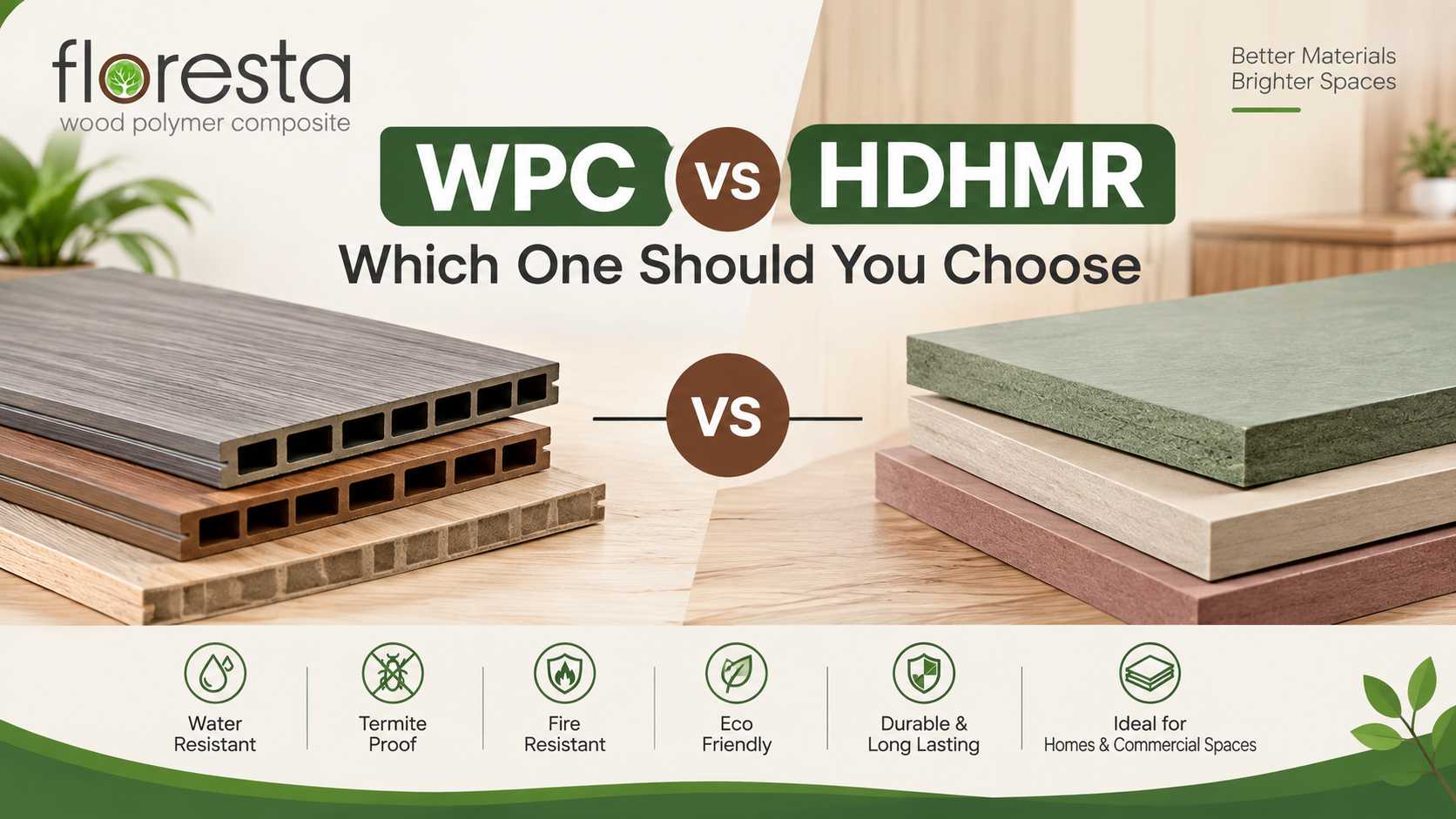
WPC VS HDHMR WHICH ONE SHOULD YOU CHOOSE
Choosing the right board material can make a significant difference to the durability, appearance, and maintenance requirements of furniture, doors, partitions, and interior applications. Two materials that are increasingly compared by homeowners, architects, interior designers, and contractors are WPC and HDHMR.
The question “WPC vs HDHMR which is better?” does not have one universal answer. Both materials have their own strengths, and the better choice depends on where the material will be used, how much moisture it will encounter, the required durability, design expectations, and budget.
While HDHMR is known for its high-density construction and strong surface characteristics, WPC offers a different combination of moisture resistance, dimensional stability, and wood-like usability.
In this guide, we compare WPC vs HDHMR across material composition, moisture resistance, durability, termite resistance, applications, maintenance, cost considerations, and installation to help you make a more informed decision.
What Is WPC?
WPC stands for Wood Plastic Composite.
It is a composite material manufactured using wood-based material and polymer components, along with additives that help achieve the desired physical and processing characteristics.
WPC is designed to combine some of the visual and processing characteristics associated with wood with the functional advantages of composite materials.
Depending on the product, WPC can be used for:
Doors
Door frames
Wall panels
Partitions
Louvers
Furniture components
Interior architectural elements
One of the major reasons WPC is considered for interior applications is its resistance to moisture and common wood-related problems.
What Is HDHMR?
The HDHMR full form is High Density High Moisture Resistance.
HDHMR board is an engineered wood-based panel manufactured under controlled conditions to achieve higher density and moisture resistance compared with conventional MDF.
It is commonly used for:
Modular furniture
Kitchen cabinets
Wardrobes
Storage units
Interior furniture
Shelving
Decorative panels
HDHMR is particularly popular in furniture and interior applications where a smooth, dense surface is required for painting, laminating, routing, or other finishing processes.
However, HDHMR remains an engineered wood-based board, so its moisture performance should not automatically be interpreted as equivalent to a fully moisture-resistant composite product.
WPC vs HDHMR: Key Difference
The fundamental difference between the two materials comes from their composition.
WPC combines wood-based material with polymers to form a composite.
HDHMR is an engineered wood panel designed with higher density and improved moisture resistance compared with standard MDF.
This difference influences how the materials behave in environments involving moisture, termites, machining, finishing, and long-term maintenance.
WPC vs HDHMR Comparison
The actual performance of either material depends on the specific product formulation, manufacturing quality, installation, and environment.
WPC vs HDHMR: Moisture Resistance
Moisture resistance is one of the most important differences to consider.
HDHMR is specifically engineered to provide better moisture resistance than conventional MDF. This makes it useful for furniture in areas where occasional humidity or moisture exposure is expected.
However, prolonged exposure to water is still a concern for engineered wood boards.
WPC, on the other hand, is often selected for applications where moisture resistance is a major consideration.
This can make WPC particularly attractive for:
Bathroom doors
Utility areas
Moisture-prone interiors
Door frames
Certain kitchen applications
Semi-outdoor protected areas, depending on product specifications
Which is better for moisture?
For applications where moisture exposure is a significant concern, WPC generally has an advantage over HDHMR, provided the specific WPC product is designed for that environment.
For normal interior furniture away from direct water exposure, HDHMR can be an appropriate choice.
WPC vs HDHMR: Termite Resistance
Termite protection is another important consideration in India.
HDHMR is a wood-based engineered board, so buyers should check the manufacturer's treatment and termite-resistance specifications.
WPC is a composite material and is generally designed to resist termite-related deterioration.
This can make WPC attractive for:
Door frames
Doors
Bathroom applications
Long-term interior installations
Areas where termite concerns are significant
However, termite protection for a building should never be considered only at the door or board level. Surrounding wood, furniture, walls, flooring, and other materials may still be susceptible.
WPC vs HDHMR: Durability
Both WPC and HDHMR can provide good durability when used correctly.
HDHMR's high-density construction gives it a strong and relatively uniform surface, making it popular for furniture and cabinetry.
It can perform well when:
Correctly installed
Properly finished
Protected from excessive moisture
Used within its intended application
WPC offers durability through its composite construction and resistance to moisture and common biological concerns.
For doors and frames, WPC can be particularly useful because these components need to withstand repeated opening, closing, hardware loads, and environmental changes.
Which lasts longer?
There is no universal answer.
The lifespan of either material depends on:
Product quality
Thickness
Density
Construction
Installation
Moisture exposure
Hardware
Usage
Maintenance
The right material for the application will generally outperform a material chosen only because it is cheaper or more readily available.
WPC vs HDHMR for Doors
This is where the comparison becomes particularly relevant.
HDHMR is widely used in furniture, but WPC has strong potential for complete door systems.
WPC doors can be used in:
Bedrooms
Bathrooms
Kitchens
Offices
Utility rooms
Commercial interiors
A complete WPC door system can include the shutter, frame, hinges, locks, handles, and installation.
The moisture-resistant characteristics of WPC make it particularly attractive for bathroom and utility-area doors.
HDHMR may be considered for interior furniture and selected door-related applications, but buyers should confirm its suitability for the exact door construction and environmental conditions.
Better choice for doors: WPC
For applications specifically requiring a moisture-resistant, termite-resistant door solution, WPC is generally the more suitable choice.
WPC vs HDHMR for Furniture
The answer changes when furniture is the primary application.
HDHMR has a strong position in furniture and cabinetry because of its:
Dense surface
Smooth finish
Machinability
Compatibility with laminates
Paintability
Availability in furniture-oriented formats
It can be used for:
Wardrobes
Kitchen cabinets
TV units
Storage units
Office furniture
Shelving
WPC can also be used for selected furniture applications, particularly where moisture resistance is important.
Better choice for standard interior furniture: HDHMR
For conventional indoor furniture located away from direct moisture exposure, HDHMR can be a practical and cost-effective option.
For moisture-sensitive areas, WPC deserves stronger consideration.
WPC vs HDHMR for Bathrooms
Bathrooms are among the clearest examples of where material selection matters.
High humidity, water splashes, condensation, and repeated moisture exposure can affect wood-based materials.
HDHMR offers better moisture resistance than conventional MDF, but it is still important to protect the board and follow the manufacturer's recommended application.
WPC is commonly considered for bathroom doors and other moisture-prone architectural applications because of its moisture-resistant characteristics.
Winner for bathroom doors: WPC
For bathroom doors and frames, WPC is generally the stronger choice when the selected product is specifically designed for moisture-prone environments.
WPC vs HDHMR: Maintenance
Maintenance requirements also influence the total ownership experience.
WPC generally requires relatively straightforward cleaning and does not require the same type of periodic wood treatment associated with natural timber.
HDHMR furniture can also be relatively easy to maintain, particularly when it has been properly laminated, painted, or finished.
However, water leakage and prolonged moisture exposure should be avoided with any engineered wood furniture.
For both materials:
Clean surfaces regularly
Avoid harsh chemicals
Repair damaged edges or finishes promptly
Keep hardware properly adjusted
Follow the manufacturer's maintenance instructions
WPC vs HDHMR: Cost
Price is often the deciding factor, but comparing the two materials purely on cost per square foot can be misleading.
The final project cost may include:
Board or WPC material
Cutting
Edge treatment
Lamination
Painting
Hardware
Frame
Labour
Installation
Transportation
Maintenance
HDHMR may be an economical choice for standard furniture applications.
WPC can offer better overall value where moisture resistance, termite resistance, or long-term low maintenance are important.
Therefore, instead of asking only “Which is cheaper?”, ask:
“Which material provides the required performance at the lowest total ownership cost?”
WPC Board vs HDHMR Board: Which One Should You Choose?
The simplest way to approach the decision is by application.
This is not an absolute rule. Product specifications should always be checked before final selection.
Common Mistakes When Choosing Between WPC and HDHMR
Choosing Only on Price
The lowest initial price does not necessarily mean the lowest long-term cost.
Ignoring Application
A board that works perfectly for a wardrobe may not be appropriate for a bathroom door.
Not Checking Specifications
“WPC” and “HDHMR” describe material categories, but products within each category can vary significantly.
Overlooking Installation
Poor installation can reduce the performance of even a high-quality material.
Forgetting Hardware Compatibility
For doors, hinges, locks, handles, and frames must all work together.
Why Choose Floresta for WPC Solutions?
Floresta focuses on WPC solutions for modern residential and commercial applications.
For customers considering WPC vs HDHMR, the most important question is not simply which material is better in general, but which material is better for the specific application.
Floresta's WPC solutions are suited to customers looking for practical characteristics such as moisture resistance, termite resistance, durability, low maintenance, and contemporary appearance.
For doors, frames, partitions, louvers, and other architectural applications, selecting a WPC product designed specifically for the intended use can provide a more reliable solution than adapting a furniture board to an unsuitable environment.
Final Verdict: WPC vs HDHMR — Which Is Better?
So, which is better, HDHMR or WPC?
The answer depends on what you are building.
Choose WPC when:
Moisture resistance is important
You need a door or door frame
Termite resistance is a priority
The product will be exposed to humidity
Low maintenance is important
You want a durable architectural material
Choose HDHMR when:
You are manufacturing indoor furniture
A smooth, dense furniture surface is required
Laminates or paint finishes are planned
The application has limited moisture exposure
Cabinetry and wardrobes are the main requirement
In short:
For moisture-prone architectural applications and doors → WPC
For conventional indoor furniture and cabinetry → HDHMR
The best material is ultimately the one that matches the environment, performance requirements, design, and expected service life.
Conclusion
The WPC vs HDHMR debate is less about declaring one material universally superior and more about understanding where each material performs best.
HDHMR is a useful engineered board for furniture, cabinetry, wardrobes, office interiors, and other applications where a dense, smooth, machinable surface is required. WPC, meanwhile, offers distinct advantages for doors, frames, partitions, louvers, and moisture-prone applications where resistance to moisture and termites is important.
When comparing WPC board vs HDHMR board, consider the complete application rather than the material name alone. Evaluate moisture exposure, durability, maintenance, dimensions, finish, installation, hardware, and total project cost.
For homeowners, architects, interior designers, and builders exploring modern door and interior solutions, Floresta's WPC range provides an option designed around the practical demands of contemporary spaces.
The right decision is simple: match the material to the application, not the other way around.
Frequently Asked Questions
1. WPC vs HDHMR — which is better?
WPC is generally better for moisture-prone applications and doors, while HDHMR is well suited to conventional indoor furniture and cabinetry.
2. Is WPC better than HDHMR for bathrooms?
For bathroom doors and frames, WPC is generally the more suitable option because of its moisture-resistant characteristics.
3. What is the full form of HDHMR?
HDHMR stands for High Density High Moisture Resistance.
4. Is HDHMR waterproof?
HDHMR is designed to offer improved moisture resistance compared with conventional MDF, but it should not automatically be treated as completely waterproof.
5. Which is better for furniture, WPC or HDHMR?
HDHMR is widely suited to indoor furniture, while WPC can be preferable for furniture or architectural applications where moisture resistance is a higher priority.